English
 Chinese
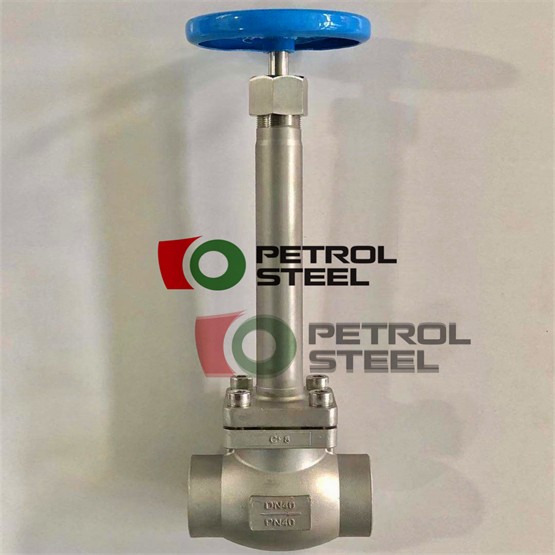
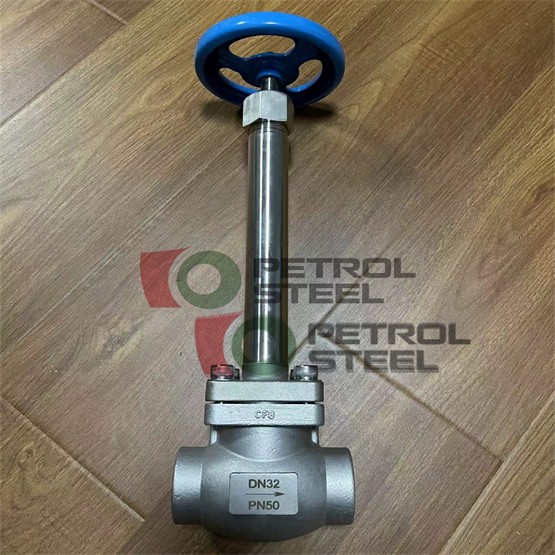
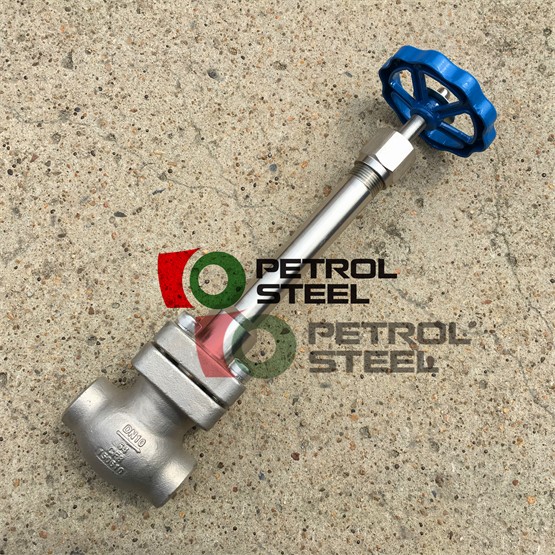
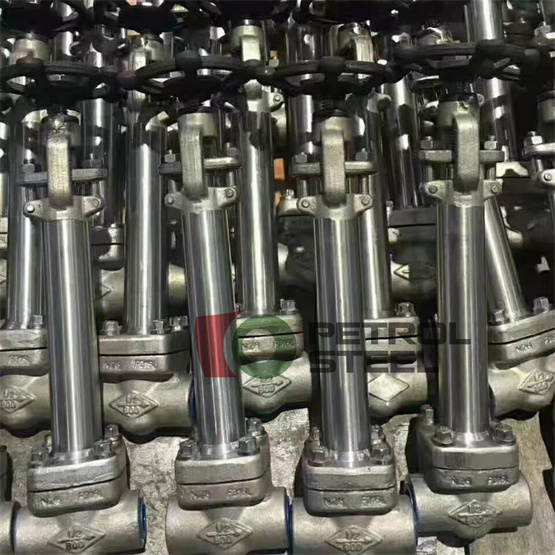
What Is a -196°C Cryogenic Globe Valve?
A cryogenic globe valve is an isolation valve designed for low-temperature applications where conventional valve designs may not be suitable.
For services approaching **-196°C**, valve selection requires consideration of more than the nominal temperature rating. Material behavior, sealing performance, stem arrangement, extended bonnet design, operating requirements and cryogenic testing may all affect valve performance.
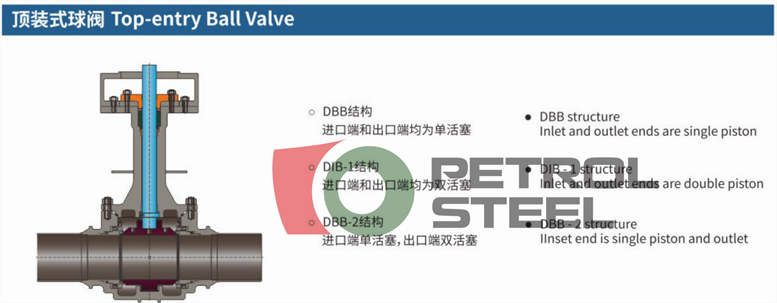
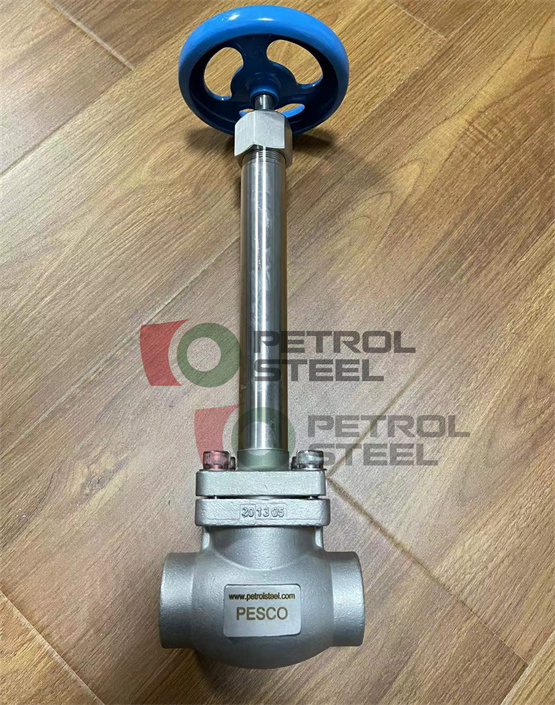
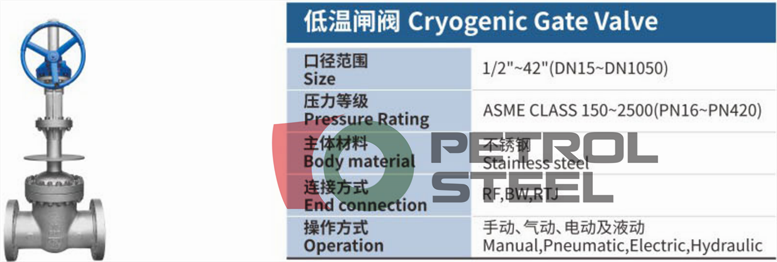
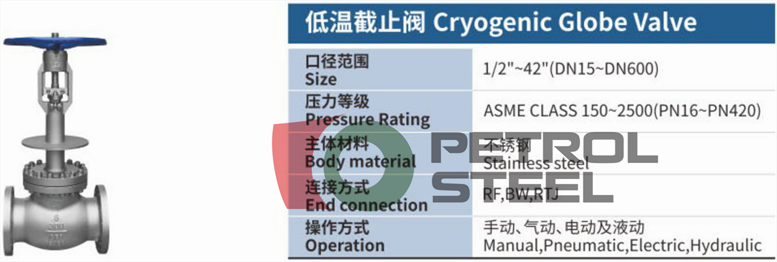
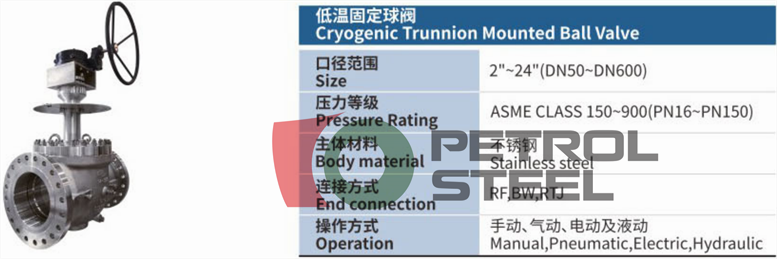
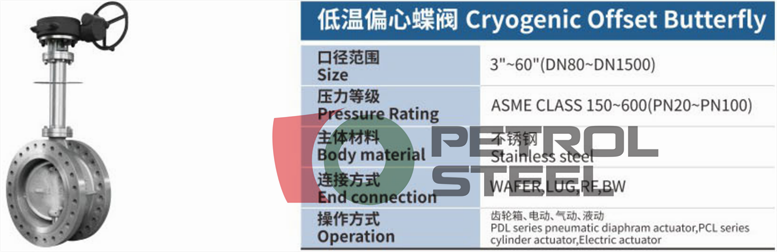
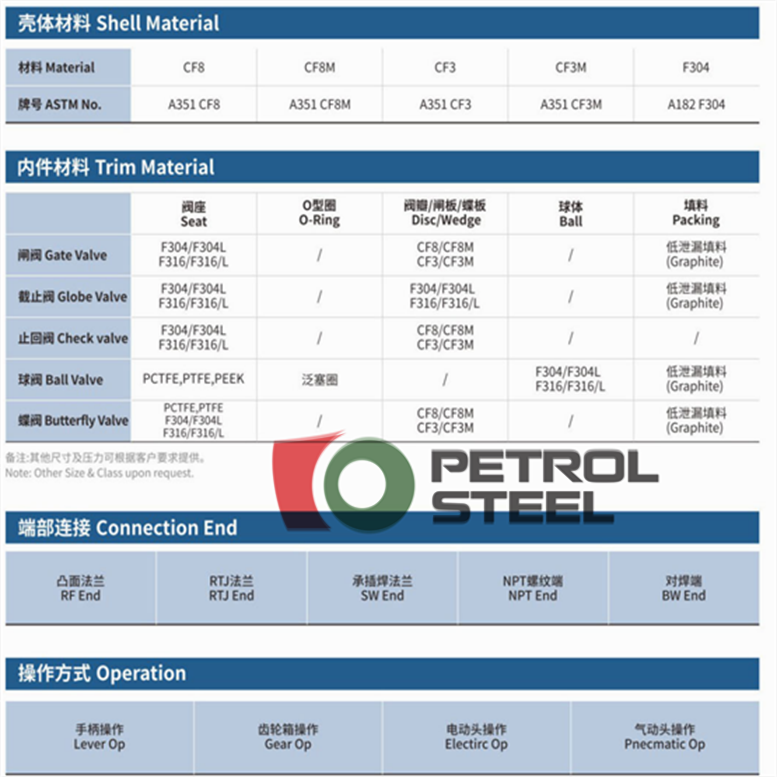
PETROL STEEL CO., LTD's -196 Celsius cryogenic globe valves and low-temperature valve specification range: 1/2"-60" (DN15-DN1500) diameter up to 500 mm, pressure class ASME CLASS 150-2500 (PN16-PN420), applicable temperature minimum -253°C, Connection: FR, BW, SW, RTJ, WAFER, LUG, etc. Mainly used in gas liquefaction equipment, air separation equipment, natural gas liquefaction, storage and transportation equipment; liquid oxygen, nitrogen, argon, hydrogen and carbon dioxide cryogenic storage tanks and tankers; and pressure swing adsorption oxygen and nitrogen equipment. Widely used in energy, petrochemicals, metallurgy, aerospace, the nuclear industry, railways and other industries.
Why Is an Extended Bonnet Used?
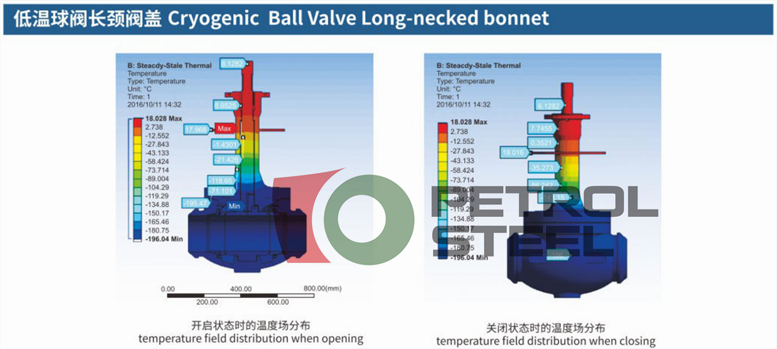
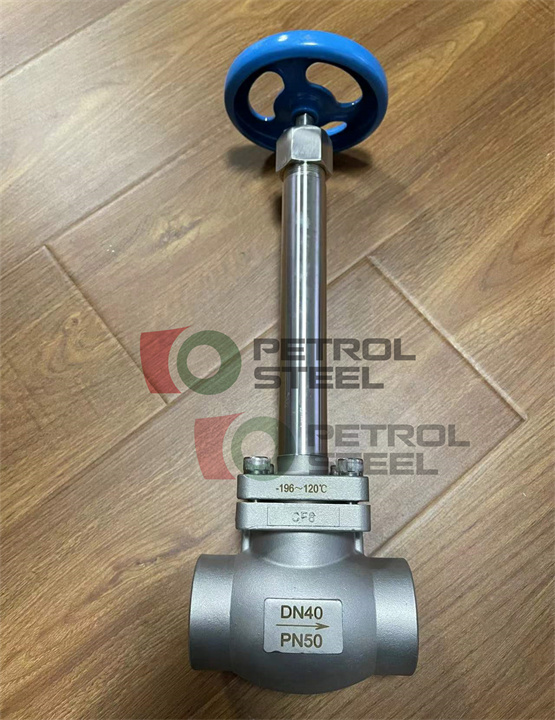
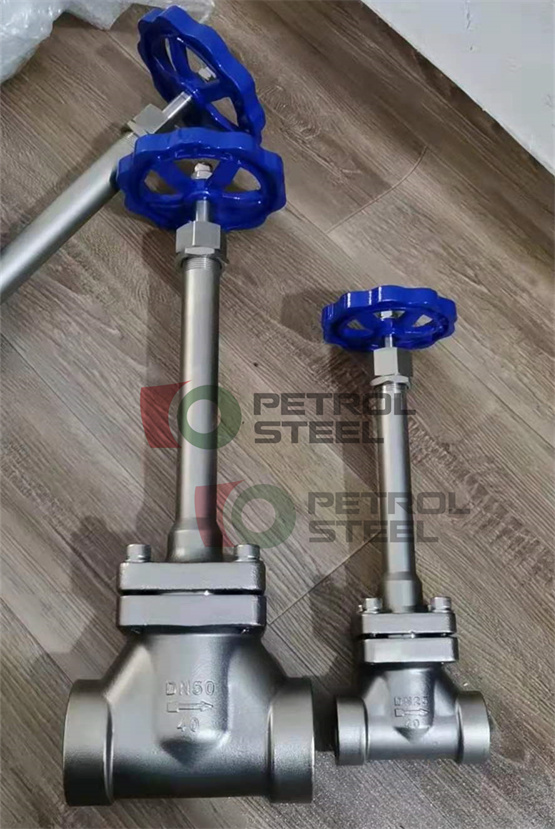
Cryogenic globe valves commonly use an **extended bonnet** to separate the extremely cold process region from the stem packing and operating area.
The bonnet extension can help reduce the transfer of extreme cold toward the packing system and maintain more favorable conditions for stem sealing and operation.
Depending on the valve design and project requirements, the extended bonnet arrangement may also provide space for insulation and installation.
The required bonnet extension should not be selected solely by copying a standard dimension from another valve. Buyers should verify the applicable design standard, valve size, service temperature, installation arrangement and project specification.
For EPC projects, a GA drawing should be reviewed and approved before production.
Technical Specification
| Items | Specifications |
| Valve Type | Cryogenic Globe Valve |
| Service Temperature | Down to -196°C, subject to project requirements |
| Nominal Size | According to project requirements |
| Pressure Rating | According to project requirements |
| Valve Body | Project-specific material |
| Bonnet | Extended bonnet |
| Stem | Project-specific cryogenic-compatible material |
| Disc | Project-specific material |
| Seat | According to service and specification |
| Packing | According to cryogenic service requirements |
| End Connection | Flanged / Butt Weld / Socket Weld / Other |
| Operation | Manual / Gear / Pneumatic / Electric, as specified |
| Testing | According to applicable standard and project specification |
| Inspection | Manufacturer / Third-party / Purchaser witness as required |
| Documentation | According to agreed QA/QC requirements |
PETROL STEEL CO., LTD always adheres to the quality policy of "all for the user" and abides by the corporate philosophy of "customer-centred, quality-based survival, and technology-based development". The service tenet of "Excellence, Integrity, Integrity and Week" for PESCO-196°C Cryogenic Globe Valves is to become one of the most professional cryogenic valve suppliers in China, providing customers with higher quality products, more competitive prices, and faster and more complete services. Continuously improving the quality of our products, we are willing to work with users, relying on our honest labour, to carry out extensive and various forms of sincere cooperation to create a brilliant tomorrow for cryogenic valves.
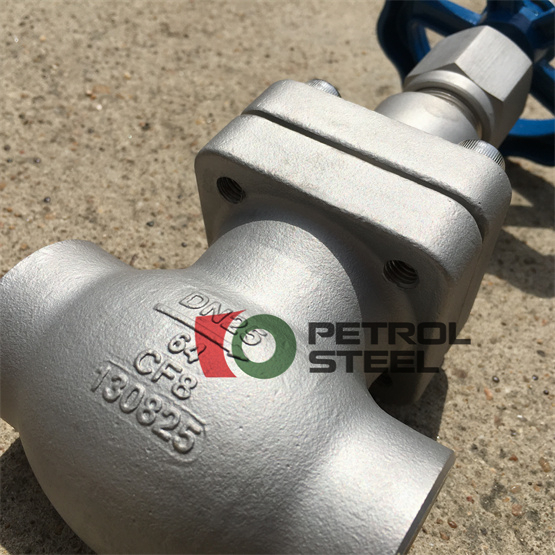
Cryogenic Testing & Inspection
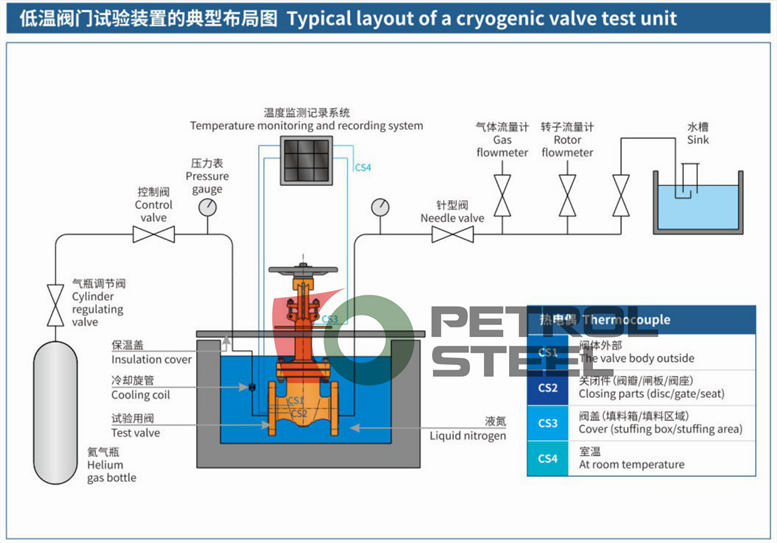
For critical cryogenic applications, ambient pressure testing alone may not demonstrate how a valve behaves at the specified low temperature.
Depending on the project specification and applicable standard, cryogenic testing may include:
Cooling to the specified cryogenic temperature
Temperature stabilization
Shell testing
Seat leakage testing
Valve opening and closing
Operating force or torque verification
External leakage verification
Helium testing where specified
Test data recording
Final inspection
For valves specified for service approaching -196°C, buyers should clearly define the required cryogenic testing scope in the RFQ or purchase specification.
Cryogenic testing requirements should be agreed before production.
PETROL STEEL CO., LTD's -196 Celsius degree Cryogenic Globe Valves are widely used in fertiliser, LNG and petrochemical fields. Valves suitable for medium temperatures of -40°C to -250°C are called low-temperature valves. Cryogenic valves include cryogenic ball valves, cryogenic solenoid valves, cryogenic gate valves, cryogenic globe valves, cryogenic safety valves, cryogenic check valves, cryogenic butterfly valves, cryogenic needle valves, cryogenic throttle valves, cryogenic pressure-reducing valves, cryogenic electric control valves, and cryogenic pneumatic valves. Except for liquid nitrogen and other liquid inert gases, most media controlled by low-temperature valves, such as regulating valves, are flammable and explosive, and they gasify when heated or flashing, causing rapid volume expansion that can lead to leakage. explode. Based on the characteristics of the medium and the requirements for the valve to be used at low temperatures, the design, manufacture, testing and installation methods of low-temperature valves differ from those of ordinary valves.
1. Standards and definitions of PETROL STEEL CO., LTD's -196 Celsius degree Cryogenic Globe Valves
Different standards have different definitions for cryogenic valves.
1) The British valve standard BS6364 "Valve for low temperature" is suitable for the medium temperature range of -50°C to -196°C.
2) The US standard MSSSP-134 "Requirements for Cryogenic Valves and Their Valve Body/Bonnet Extensions" interprets the low temperature as "for standard practice, the low temperature range is between -100°C and -195°C";
3) The Chinese national standard GB/T 24925 "Technical Conditions for Low Temperature Valves" is applicable to the medium temperature range of -29°C to -196°C;
4) The standard SHELL MESC SPE 77/200 "Valve for low temperature and ultra-low temperature" is suitable for a medium temperature range of ~-30°C to ~-196°C.
5) Foreign countries are generally divided into six temperature grades according to the liquefaction temperature of various gases under normal pressure.
Level 1 is ~0 to -46°C.
Level 2 is ~-47 to -60°C.
Level 3 is ~-61~-70°C.
Level 4 is ~-71 to ~-101°C.
Level 5 is ~-102 to -196°C.
Level 6 is below -253°C.
Generally, -46~-150°C is called low temperature, and below -150°C is called ultra-low temperature. The petrochemical industry defines cryogenic valves according to the design temperature of the conveying medium. Generally, the valves used in the medium temperature below -40°C are called low-temperature valves, and the valves used in the medium temperature below -101°C are called ultra-low-temperature valves.
2. Design characteristics of PETROL STEEL CO., LTD's -196 Celsius degree Cryogenic Globe Valves.
1. Material selection of cryogenic valve
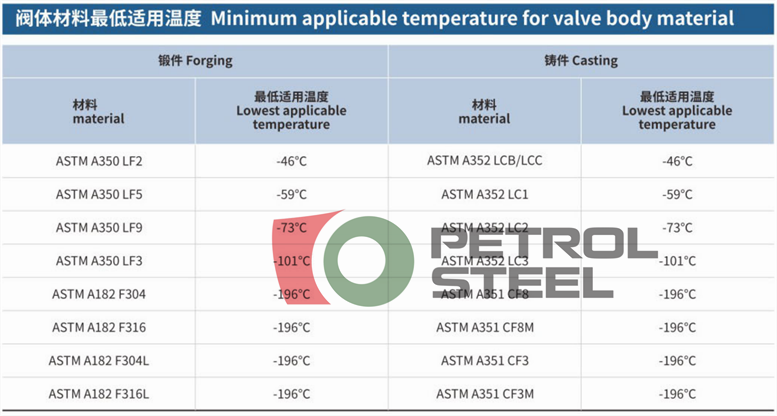
The working medium of the cryogenic valve is not only low in temperature but also has high permeability, which determines many special requirements for valve materials. The mechanical properties of steel at low temperature are different from those at normal temperature. In addition to strength, the important index of low-temperature steel is its low-temperature impact toughness. The low-temperature impact toughness of the material is related to its brittle transition temperature. The lower the brittle transition temperature of the material, the better its low-temperature impact toughness. Metal materials with a body-centred cubic lattice, such as carbon steel, exhibit low-temperature cold brittleness, while the impact toughness of metal materials with a face-centred cubic lattice, such as austenitic stainless steel, is basically unaffected by low temperature.
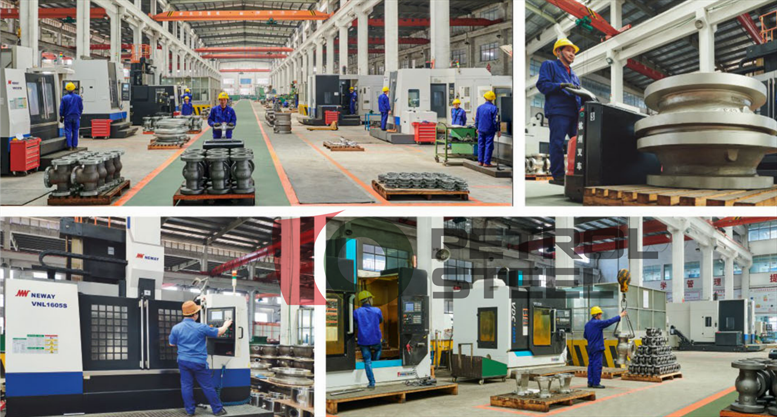
The materials of PETROL STEEL CO., LTD's low-temperature valve body, valve cover and other pressure parts are usually made of tough materials with good low-temperature strength, and factors such as weldability, machinability, stability and economy must also be considered. When designing, three low-temperature grades of -46°C, -101°C and -196°C are commonly used. -46°C low-temperature grade generally uses low-temperature carbon steel, and the -101°C and -196°C low-temperature grades generally use 300 series austenitic stainless steel, which has moderate strength, high toughness and good processing performance.
2. Structural design of Petrochemical PETROL STEEL CO., LTD's cryogenic valves
1) Bonnet structure design
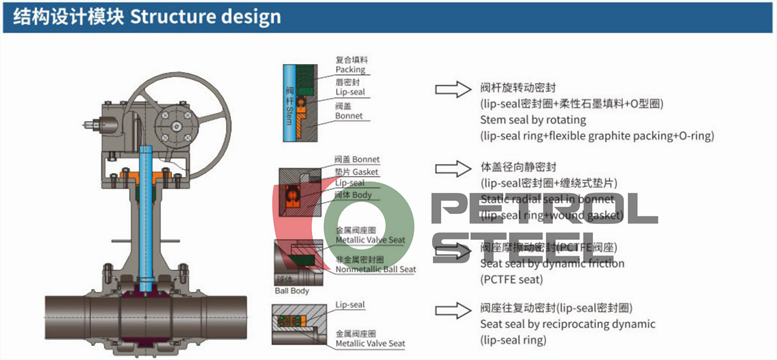
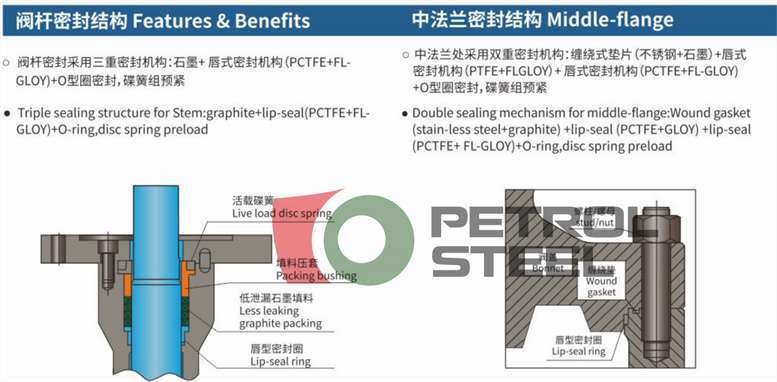
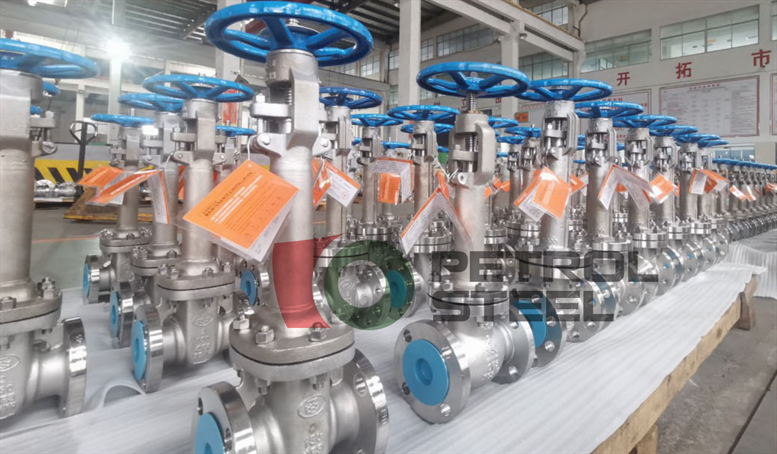
A notable feature of -196 degrees Celsius cryogenic globe valves is that the bonnet is generally a long-neck structure, and it is also clearly stipulated in GB/T24925 "Technical Conditions for Cryogenic Valves" that "the bonnet of cryogenic gate valves, globe valves, ball valves and butterfly valves should be used according to different applications. " The temperature requirements are designed to be a long-neck bonnet structure that is convenient for cold insulation so as to ensure that the temperature at the bottom of cold insulation layer, the long-neck valve cover facilitates cold insulation construction, and the packing gland is located outside the cold insulation layer, allowing for the tightening of gland bolts or the addition ofof the operator caused by the temperature being too low but also ensure that the stuffing box and the gland are used at normal temperature to prevent the packing.
The sealing performance is reduced, and the service life of the packing is extended. Because in the low-temperature state, with the decrease of temperature, the elasticity of the packing gradually disappears, and the leak-proof performance decreases. The packing of the -196 degree Celsius cryogenic globe valves will be scratched, causing serious leakage. Therefore, the low-temperature valve must adopt the long-neck bonnet structure. In addition, the long neck structure also facilitates the winding of cold insulation materials to prevent cold-energy loss. Since the low-temperature pipeline generally has a thicker cold insulation layer, the long-neck valve cover facilitates cold insulation construction, and the packing gland is located outside the cold insulation layer, allowing for the tightening of gland bolts or the addition of packing at any time when necessary without damaging the cold insulation layer.
Bonnet extensions are specified in BS6364, MSS SP-134 and SHELL MESC SPE77/200 standards. Among them, BS6364 specifies the lengthened dimension of 15~500 with a cold box and stipulates that the minimum length of a non-cold box should be 250 mm; MSS SP-134 includes the lengthened dimension requirements of 15~300 with a cold box and non-cold box. In comparison, the non-cold box extension is longer than the BS6364 specification, and the cold box extension is shorter than the BS6364 specification. SHELL MESC SPE 77/200 does not distinguish between cold box and non-cold box and specifies the length of 15 to 1200 in different temperature ranges.
Taking into account comprehensively, SHELL MESC SPE 77/200 has a wide range of extended lengths, which is more convenient and reliable to use. If it is used in low-temperature critical occasions, it can be designed with reference to the SHELL MESC SPE 77/200 standard or according to the special length requirements of the design unit. In addition, when selecting the length, it is also necessary to consider whether the thickness of the designed cold insulation layer is greater than the length; if so, it should be lengthened to match the thickness of the cold insulation.
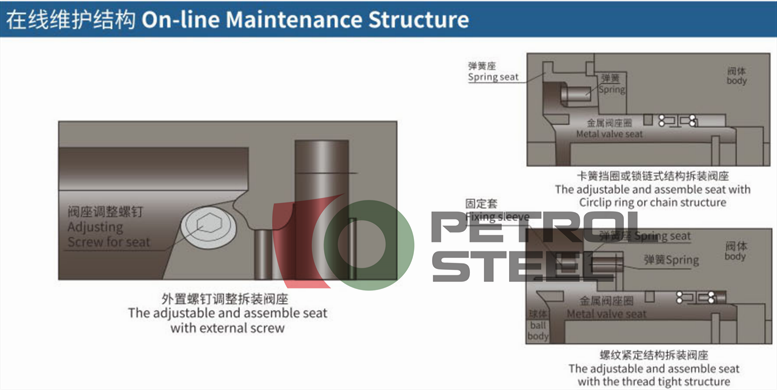
2) Structural design of drip board
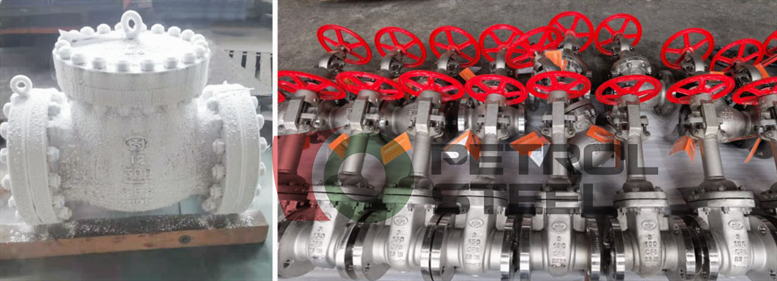
Since the transmission in the valve is a low-temperature medium, to avoid or reduce the transmission of the medium temperature to the filling material at the valve stem and its upper end and prevent these materials from failing due to freezing, a drip plate structure can be added to the -196 degree Celsius cryogenic globe valves. Some research institutions have carried out experimental verification on the valve with the drip plate structure and have proved that the upper end of the valve cover with the drip plate has a higher temperature. Due to the low temperature of the upper part of the extended valve cover, the valve is usually exposed to the air, and the water vapour in the air will liquefy into water droplets when it encounters the low-temperature valve cover. The diameter of the drip plate exceeds the diameter of the middle flange, which can prevent low-temperature liquefaction. Water vapour drips onto the middle flange bolts to prevent rust on the bolts from affecting online maintenance. In addition, the drip plate needs to be set on the outside of the cold insulation layer, which can prevent the condensed water droplets from falling on the cold insulation layer and the upper part of the valve body and protect the cryogenic globe valves with a cooling capacity at -196 degrees Celsius.
3) Structural design of pressure relief components
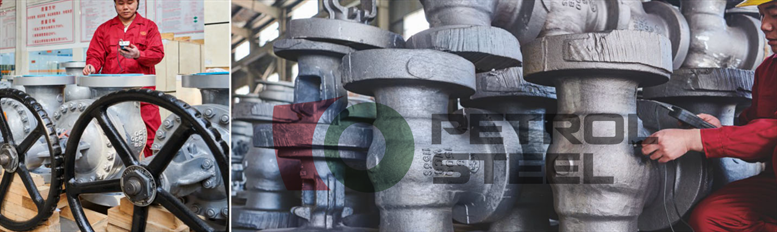
For -196 degrees Celsius cryogenic globe valves with a closed cavity structure, when used in flammable, explosive and easily vaporised media, there are special requirements for the valve sealing structure. Some low-temperature media will increase in volume after vaporisation. For example, the volume of liquefied natural gas after vaporisation is more than 600 times that of the liquid state. When the valve is closed and the ambient temperature is relatively high, the low-temperature medium in the valve body absorbs the environment. It is gradually vaporised by medium heat, and its volume rises rapidly, resulting in overpressure inside the valve, even threatening the safety of the valve, causing medium leakage or even a fire accident. The design of the fireproof structure mainly addresses the fact that the inner cavity of the valve is abnormally overpressured. Such as low-temperature gate valves and ball valves, due to different valve sealing principles, there will be obvious differences in pressure relief design. However, different manufacturers have their own unique characteristics in the design of the pressure relief structure.
4) Anti-static and fireproof structure design
Since -196 degrees Celsius cryogenic globe valves are generally used in flammable and explosive media, anti-static design and fire protection design are particularly important. The anti-static design mainly uses a current-guiding method similar to a lightning rod to conduct the valve stem and the valve body so as to export static electricity to eliminate potential safety hazards and ensure the supply safety of the entire system. For example, GB/T24925 clearly stipulates that "for valves with soft valve seats or soft closing inserts used for flammable vapours or liquids, the design should ensure that the valve body and valve stem have electrical continuity, and the large resistance of the discharge path should not exceed 10Ω. " The design of the fireproof structure mainly addresses the problem of medium leakage caused by drastic temperature changes. The design of the fireproof structure is similar to the design requirements of ordinary valves.
Buyer Note
A "-196°C" temperature marking alone should not be considered sufficient evidence of cryogenic performance.
Buyers should review the applicable standard, test scope, test temperature, acceptance criteria and documentation requirements before placing an order.
Quality Assurance for Cryogenic Valve Procurement
PETROL STEEL supports project-based procurement with inspection and documentation coordination according to the agreed supply scope.
Depending on project requirements, quality documentation may include:
Material Test Certificate
EN 10204 3.1 Documentation
PMI report
Dimensional inspection report
Shell test report
Seat test report
Cryogenic test report
NDE documentation where applicable
Certificate of Conformity
Final inspection report
Packing list
Product traceability documentation
Third-party inspection documentation
The exact inspection and documentation scope should be confirmed before order placement.
Applications for LNG Facilities
Liquefied natural gas processing, storage and transfer systems.
Industrial Gas
Nitrogen, oxygen, argon and other industrial gas applications.
Air Separation Units
Cryogenic separation and associated piping systems.
Cryogenic Storage
Storage tanks, transfer systems and low-temperature piping.
Petrochemical
Low-temperature hydrocarbon and process applications.
Energy Projects
Cryogenic systems associated with energy and gas infrastructure.
Cryogenic Service: LNG, LIN, LOX and LAR
Cryogenic service should not be defined by temperature alone.
Typical applications may include:
| Medium | Typical Boiling Point at Atmospheric Pressure |
| LNG | Approximately -162°C |
| LNG | Approximately -196°C |
| LOX | Approximately -183°C |
| LAR | Approximately -186°C |
Applicable Standards
Applicable standards may include: depending on the valve configuration and project requirements
ISO 28921-1 — Valves for isolation at low temperature
BS 6364 Valves for Cryogenic Service
Valves – ASME B16.34
API 598 – Valve inspection and testing
ASME B16.5 Pipe Flanges and Flanged Fittings.
ASME B16.10 – End-to-End and Face-to-Face Dimensions
Other project-specific standards and specifications
Please confirm the applicable standard and revision in the project datasheet / purchase specification before quotation.
Compliance has to be checked according to the actual valve configuration and the determined scope of supply.
Cryogenic Valve Supply Procedure PETROL STEEL
1. RFQ Received
2. Technical Review
3. Supplier / Manufacturer Evaluation
4. Commercial & Technical Proposal
5. Drawing / Datasheet Approval
6. Production
7. Inspection & Testing
8. Third Party Inspection (If Needed)
9. Documentation Review
10. Final Packing & Shipping
We do not just quote the valve; we coordinate technical, quality and supply-chain requirements defined by the project.
Project-Based Cryogenic Valve Supply
PETROL STEEL supports international EPC contractors, industrial buyers and valve importers with project-based sourcing of cryogenic valves and piping components.
Our service focuses on:
Technical Requirement Review → Qualified Supply Chain → Inspection Coordination → Quality Documentation → International Delivery
Instead of comparing valves by price alone, we help buyers evaluate the technical scope, inspection requirements and documentation required for their specific project.
Send us your cryogenic valve RFQ for technical review.
Frequently Asked Questions
1. Can you use a cryogenic globe valve at -196°C?
Cryogenic globe valves can be designed for very low-temperature service, but suitability must be determined based on the valve design, materials, applicable standards, testing requirements, and project conditions.
2. What is an enlarged bonnet used for?
The extended bonnet helps isolate the cold valve body and process area from the stem packing and operating area, which aids sealing and operation in cryogenic service.
3. Is it possible to use a standard stainless steel globe valve at -196C?
Not really. Material grade alone does not automatically prove full cryogenic suitability. Valve design, sealing system, bonnet arrangement, testing and service conditions are also to be taken in consideration.
4. What tests are to be performed on a cryogenic valve at -196°C?
Testing may comprise shell testing, seat testing, cryogenic testing, operational testing, external leakage testing and helium testing as specified, depending on the applicable standard and project specification.
5. Do you have a cryogenic test report?
Cryogenic testing and documentation can be performed to the mutually agreed project requirements and inspection scope. The test temperature, procedure, acceptance criteria and reporting requirements shall be agreed before production.
6. Are these valves LNG compatible?
Cryogenic globe valves can be used in LNG applications if the design selected meets the requirements for temperature, pressure, medium, materials, standards and testing.
7. Are they compatible with LOX?
Potentially, but oxygen service requires additional consideration of material compatibility, cleanliness, degreasing and contamination control. The LOX requirements should be explicitly identified in the RFQ.
8. Do you have a third-party inspection?
3rd-party inspection can be arranged as required by the purchaser or project specification. The scope and inspection agency should be agreed upon prior to inspection.
9. What information is required for a quotation?
At the very least
Size + Pressure Class + Medium + Design Pressure + Minimum Design Temperature + End Connection + Applicable Standard + Inspection Requirements.
Additional data sheets and project specs are preferred.
10. Why are the prices of cryogenic globe valves different between suppliers?
Prices are subject to change based on material, pressure class, bonnet configuration, seat and packing material, testing, inspection, certification, documentation and other project specific requirements.
Request a Quote for Your Cryogenic Globe Valve
Required information is as follows.
Valve Size: NPS / DN
Pressure Class: Class / PN
Medium: LNG / LIN / LOX / LAR / Other
Minimum Design: Temperature °C
Design Pressure: MPa / bar
End Connection: Flanged / BW / SW / Other
Applicable Standard: BS 6364 / ISO 28921-1 / ASME / API / Project Spec
Quantity: pcs
Required Delivery Date: Date
Inspection Requirement: Manufacturer / Third Party / Purchaser Witness
https://www.petrolsteel.com/Contact-us.html
Tel/Fax: +86 10 8599 9168
Cell/WhatsApp/WeChat: +86 159 0035 7871
Email: sales@petrolsteel.com, jackywinn@foxmail.com